

Greetings
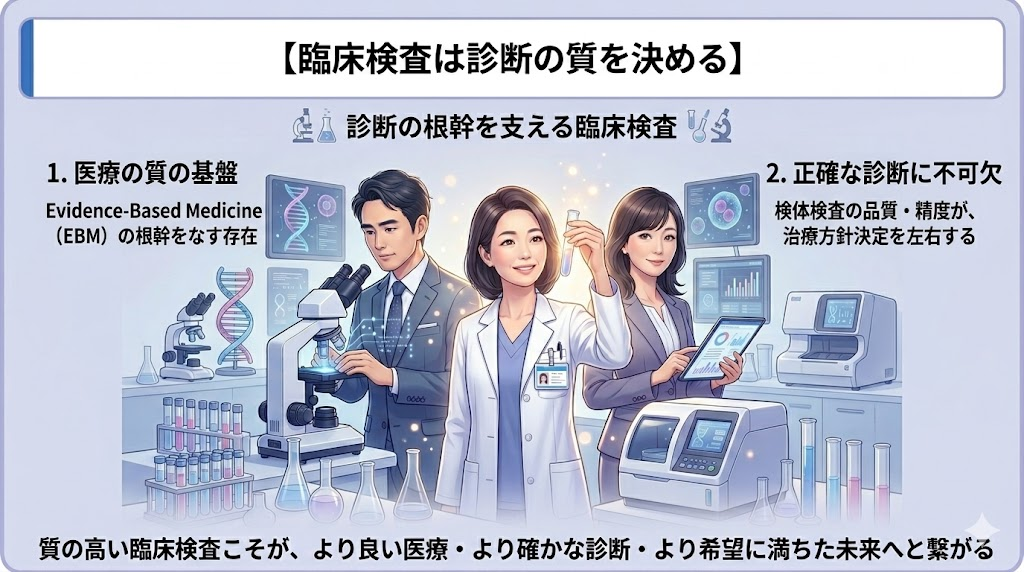
Department of Clinical Laboratory Medicine, operating under the philosophy and basic policies of Tokai University Hospital, is engaged in clinical practice with the pillars of providing rapid and high-quality clinical tests, which are essential for providing patients with high-quality and safe medical care, and supporting clinical practice, education, and research that leverage the expertise of a university hospital. We support daily clinical practice based on the philosophy that "clinical testing guides diagnosis and determines the quality of medical care."
There is an international standard for clinical laboratories called ISO 15189 (Clinical laboratories – Specific requirements for quality and competence), which is a third-party evaluation that assesses whether clinical laboratories are able to provide rapid and high-quality clinical tests. Tokai University Hospital has obtained ISO 15189 certification and has established and operates a quality management system based on its requirements. Under a rigorous management system, we work diligently every day in collaboration with Medical Technology Department to provide the best possible test results to attending physicians and patients. Test data is not just numbers; it is important medical information that influences diagnosis and treatment plans. We are deeply aware of this responsibility.
From April 2025, we opened an outpatient ultrasound examination service (regional quota: abdomen and superficial organs) Monday through Friday (starting at 2:00 PM). As part of our contribution to regional healthcare, we will provide highly specialized ultrasound diagnostics. Furthermore, as Department of Clinical Laboratory Medicine of a university hospital, we have an important mission to develop new clinical tests. We are promoting research and development directly linked to clinical practice in cutting-edge fields such as infectious disease diagnosis and genetic testing.
One of the important missions of Department of Clinical Laboratory Medicine at a university hospital is the development of new clinical tests. As exemplified by the clinical testing for SARS-CoV-2, we aim to conduct research and development that benefits not only the patients who visit our hospital, but also medical staff, the community, and the country, by working closely with clinical departments in response to the ever-changing medical situation.
Department of Clinical Laboratory Medicine strives to provide reliable testing and diagnosis in cooperation with various healthcare professionals. Please do not hesitate to contact us if you have any questions or concerns. Thank you for your cooperation.
Chief of Department of Clinical Laboratory Medicine Department
Treatment details
Department of Clinical Laboratory Medicine interprets the results of specimen testing and microbiological testing (blood, urine, biochemistry, immunology, bacteriology, genetics, etc.) and physiological testing (abdominal ultrasound, cardiac ultrasound, superficial ultrasound, Obstetrics and Gynecology ultrasound, electroencephalography, etc.). Through these tests, we contribute to the early detection of diseases, improvement of diagnostic accuracy, and evaluation of treatment effectiveness. We also work in collaboration with Medical Technology Department (clinical laboratory technologists), who are mainly responsible for measurements, to maintain the accuracy and speed of tests, and implement measures such as improving pre-consultation testing and diagnostic testing, providing consultation on testing, and infection control activities. We support safe, high-quality medical care and efficiency in each clinical department, and also play a role in bridging the gap between the "clinical setting" and the "measurement site." At Tokai University Hospital, many routine tests can be performed and diagnosed on the same day. For pre-consultation tests, many blood tests and biochemical tests are reported with accurate results within 40 minutes. We provide 24-hour emergency response and support emergency medical care. We also contribute to preventive medicine through tests provided to Health Screening Center. Highly accurate diagnostic tests performed by specialist physicians are supported by precise measurements carried out by specialized clinical laboratory technologists. In addition to specialist physicians, physicians from various clinical departments also participate in the diagnostic testing process.
Main medical achievements
In collaboration with clinical laboratory technologists in Medical Technology Department, we conduct quality control, quality assurance, and interpretation of clinical tests performed at Tokai University Hospital, based on international certification standards such as ISO 15189. Through these activities, we contribute to improving the quality of diagnosis and patient safety. Specific examples of our activities are shown below.
Testing, infection consultation, and support for appropriate antibiotic use.
Our testing and infection consultation service accepts inquiries and consultations from both inside and outside the hospital regarding matters related to testing and diagnosis, such as the selection of test items, testing plans, and interpretation of results, as well as infection control measures within the hospital.
In particular, our infectious disease testing and diagnosis services diagnose infections caused by antibiotic-resistant bacteria such as methicillin-resistant Staphylococcus aureus (MRSA) and multidrug-resistant Pseudomonas aeruginosa (MDRP), intestinal infections such as enterohemorrhagic Escherichia coli O-157, febrile viral diseases such as measles, varicella, and rubella, and respiratory infections such as influenza, SARS-CoV-2, and tuberculosis. We strive to achieve rapid and highly accurate diagnoses by utilizing advanced technologies such as nucleic acid amplification and immunological assays. We also provide support for the appropriate use of antibiotics (Antimicrobial Stewardship) through our test results. In the process of providing support for the appropriate use of antibiotics, interpretations of test data not explicitly stated in medical records and the possibility of new diagnoses may be suggested. In such cases, we actively provide feedback to the clinical side and contribute to diagnostic support.
Ultrasound diagnosis
Ultrasound examinations are used to diagnose and ensure the accuracy of examinations for upper abdominal organs such as the liver, gallbladder, pancreas, and spleen; urinary organs such as the kidneys and prostate; gynecological organs such as the uterus and ovaries; superficial organs such as the mammary glands, thyroid gland, lymph nodes, and subcutaneous soft tissue; and cardiovascular diseases such as the heart and blood vessels. Large lesions in the digestive tract, such as the colon and stomach, can be screened. Under the supervision of a specialist who also serves as an ultrasound instructor, a team of certified ultrasound technicians utilizes high-performance ultrasound diagnostic equipment to produce high-resolution images. Functional assessments, including blood flow measurement using Doppler mode and liver stiffness measurement, are also available.
Hematological diagnosis
Bone marrow examinations and flow cytometry tests are used to diagnose blood disorders such as anemia, thrombocytopenia, leukemia, malignant lymphoma, and multiple myeloma. Based on cell classification and measurements by blood laboratory specialists, physicians in Department of Clinical Laboratory Medicine prepare the final report. We aim for highly accurate blood diagnoses through a comprehensive diagnosis that integrates morphological evaluation and immunological analysis.
Doctor List
Department Head: Satomi Asai
Outpatient: 0463 (93) 1121 extension 2450 (Medical Department)
Professor Satomi Asai
| Specialization | General testing and diagnosis |
|---|---|
| Specialist | Certified Clinical Laboratory Specialist (Basic Area) by the Japan Board of Medical Specialists / Quality Control Specialist for Gene-Related Testing / Certified Specialist and Instructor by the Japan Society of Ultrasonics in Medicine / Infection Control Doctor / Certified Antimicrobial Chemotherapy Physician / Certified Clinical Microbiologist by the Japanese Society of Clinical Microbiology |
| Specialized Areas | Infectious disease testing and infection control, ultrasound examination |
| Outpatient medical day | Ultrasound examination (regional quota) outpatient clinic Monday to Friday (from 14:00) |
Professor Kazuhito Goto
| Specialization | General testing and diagnosis |
|---|---|
| Specialist | Japan Medical Specialty Board Certified Clinical Laboratory Specialist / Certified Internal Medicine Doctor by the Japanese Society of Internal Medicine / Hepatologist and Instructor by the Japan Society of Hepatology / Infection Control Doctor |
| Specialized Areas | Clinical Chemistry, Liver |
Lecturer Haruyo Atsumi
| Specialization | General testing and diagnosis |
|---|---|
| Specialist | Specialist of the Japan Society of Obstetrics and Gynecology / Certified Women's Healthcare Specialist of the Japan Society of Women's Medicine / Infection Control Doctor |
| Specialized Areas | Genetic testing, ultrasound testing |
| Outpatient medical day | Endocrinology outpatient clinic: Thursdays (AM) / Ultrasound examination (community quota) outpatient clinic: Mondays to Wednesdays and Fridays (14:00-) |
International third-party certification
Our hospital's laboratory is an ISO15189 certified facility. We strive every day to provide quality-assured test data while maintaining close communication with Medical Technology Department (clinical laboratory technologists).
Main certifications for clinical laboratory technologists
Basic Subject Area (Clinical Laboratory Technician Level 2)
-
- Microbiology: 8 people
-
- Clinical chemistry: 7 people
-
- Hematology: 25 people
-
- Immune serology: 5 people
-
- Circulatory physiology: 14 people
-
- Neurophysiology: 1 person
-
- Respiratory physiology: 5 people
Professional and Certified Qualifications
-
- Emergency Clinical Laboratory Technicians: 17 people
-
- Certified Clinical Microbiologist: 1 person
-
- Certified blood test technologists: 8
-
- Certified bone marrow technologists: 4
-
- Certified General Medical Technologist: 1 person
-
- Certified Emergency Medical Technologist: 1 person
-
- Certified electrocardiogram technician: 1 person
-
- Certified Cytometry Technicians: 3
-
- Certified Clinical Chromosome Genetic Tester: 1 person
Advanced medical care and highly specialized fields
-
- Cell therapy certified managers: 7 people
-
- Certified HLA Testing Technicians: 2
-
- Certified sleep medicine technologists: 3
Ultrasound examination (by specialty)
-
- Superficial organs: 17 people
-
- Cardiovascular: 18 people
-
- Gastrointestinal: 25 people
-
- Urinary tract: 8 people
-
- Obstetrics and Gynecology: 14 people
-
- Blood vessels: 5 people
-
- Health checkups: 4 people
Other professional qualifications
-
- Certified Diabetes Educators (Japan): 2 people
-
- Certified Genetic Analysis Scientists: 5 people
-
- Certified Clinical Cytogenetics Specialists: 2
-
- Bioinformatics Engineer: 1 person
-
- Vascular medical technicians: 5 people